Gopas and Gopis – The True Meaning of Devotion in Vrindavan
Who Are the Gopas and Gopis of Vrindavan
Gopas and Gopis are not just figures in divine stories they are the purest embodiment of love and devotion toward Lord Krishna. Their hearts were completely free from ego, desire, and worldly attachments.
Their only wish was to serve Krishna, love Him, and live for Him.
In the sacred land of Vrindavan, where every tree, river, and breeze remembers Krishna’s name, the Gopas and Gopis lived simple lives. Yet, their hearts carried the deepest spiritual truths showing that real devotion is not about rituals or knowledge, but about unconditional love and surrender.
The story of Gopas and Gopis is not merely history it is a mirror for our own souls, reminding us how love for God transforms the heart.
The Life of the Gopas and Gopis in Vrindavan
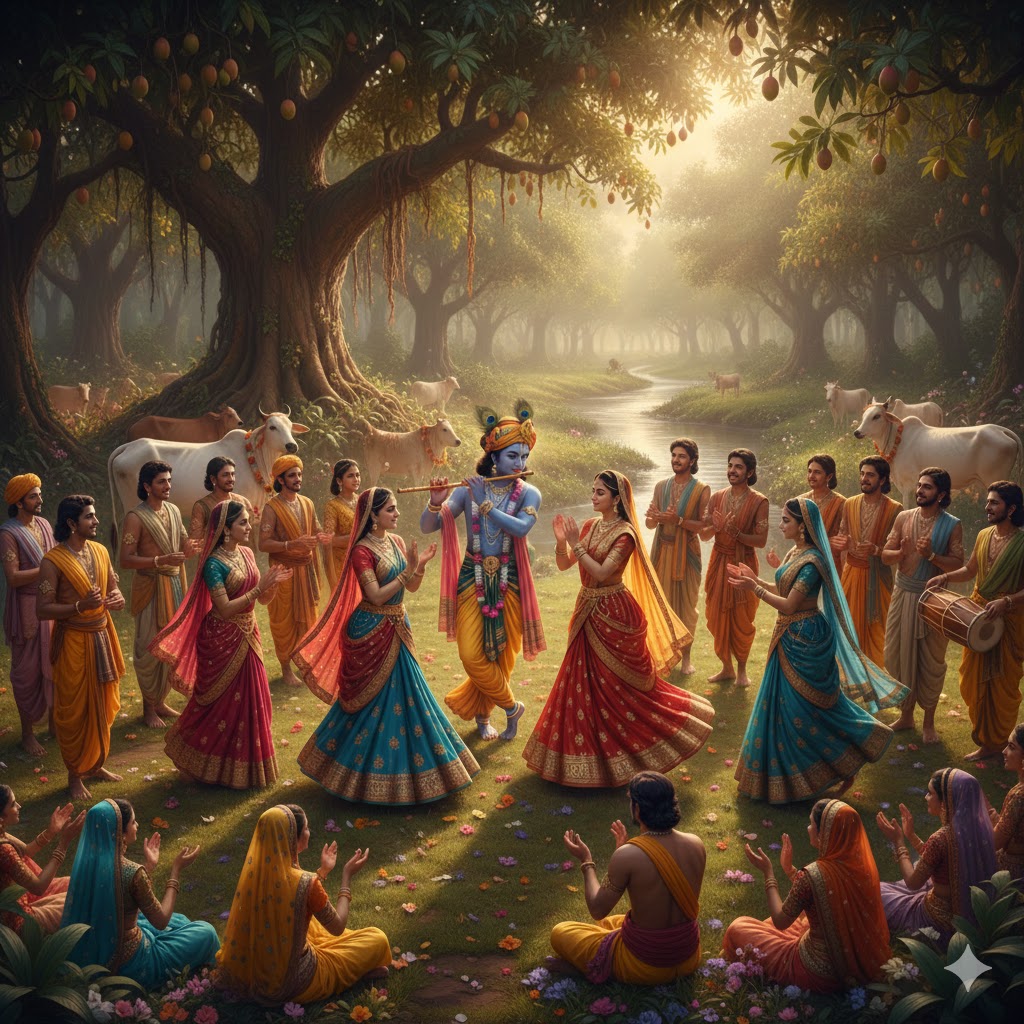
Vrindavan, the divine playground of Krishna, was filled with laughter, songs, and the sweet sound of flutes and anklets. The Gopas (cowherd boys) and Gopis (cowherd maidens) spent every day with Krishna playing, dancing, and serving Him with boundless affection.
The Gopas would wake up early to take the cows to graze. They would sing Krishna’s name, tell jokes, and share their meals with Him on the banks of the Yamuna.
The Gopis, on the other hand, were always lost in thoughts of Krishna. Whether churning butter, fetching water, or decorating themselves with flowers, their hearts were always chanting “Govinda! Gopala! Radhe Shyam!”
For them, every task was worship. Every breath was love.
The Simplicity of Devotion – Gopas and Gopis’ Way of Loving Krishna
What makes Gopas and Gopis so special is the simplicity of their devotion.
They did not meditate in caves or perform great sacrifices. Their love itself was their meditation.
The Gopas loved Krishna as their dearest friend, protecting and playing with Him.
The Gopis loved Krishna as their eternal beloved, seeing Him in every moment of their lives.
When Krishna played His flute, the Gopis would leave everything their chores, their families, even themselves and run toward the sound of His music. This was not disobedience; it was the call of the soul to its divine source.
Their love was not of this world it was param prema, the highest divine love.
The Spiritual Meaning Behind the Gopas and Gopis
Gopas and Gopis represent different moods of devotion found within every soul.
The Gopas represent Sakhya Bhava friendship and equality with God.
They remind us that we can love God as a friend, laughing and sharing our joys and sorrows with Him.The Gopis represent Madhurya Bhava the sweet, intimate love between the soul and the Divine.
Their love is free of desire; they seek nothing but Krishna’s smile.
In both forms, devotion is pure and personal where the heart sees only Krishna everywhere.
The Day-to-Day Love of the Gopas
The Gopas were simple cowherd boys, yet their hearts were vast as the sky.
They played with Krishna every day wrestling, dancing, joking, and sometimes even fighting in fun.
To the world, they looked like children, but in reality, they were great souls (Mahabhagavatas) eternally liberated beings who took birth only to serve the Lord.
When Krishna lifted the Govardhan Hill, the Gopas stood beside Him without fear, holding sticks as if they too were helping.
When Krishna went to herd cows, they followed, singing His name.
Their friendship with Krishna teaches us that God is not distant; He is a companion, a friend, a guide.
True devotion is not fear it is love that feels close, joyful, and natural.
The Love of the Gopis – Beyond Human Comprehension
The Gopis’ love for Krishna is beyond description.
They are the purest souls, each representing a unique aspect of divine love.
When Krishna played His flute under the full moon, the Gopis left their homes, their families, and everything else drawn by a force stronger than life itself.
Their hearts beat only for Krishna.
During the Raas Leela, Krishna danced with each Gopi individually, showing that the Lord becomes one with each devotee who loves Him completely.
Their love was not physical; it was spiritual union the merging of the soul with the Divine.
As the Bhagavatam says:
“Their bodies were in Vrindavan, but their minds and souls were merged completely in Krishna.”
The Meaning of Raas Leela – The Gopis’ Divine Dance
The Raas Leela is the crown jewel of the Gopis’ devotion.
When Krishna danced with them, it was not a worldly act but a cosmic expression of divine bliss the union of every soul with God.
Each Gopi felt that Krishna was dancing only with her, proving that the Lord is personally present in every heart.
This dance symbolizes the eternal truth that the Divine loves every soul equally, without division or preference.
It teaches us that in true devotion, there is no separation, no jealousy, no possession only love that celebrates the presence of God in all.
The Qualities of the Gopis’ Devotion
The Gopis’ devotion has been described by saints as the highest form of Bhakti (prema bhakti). Their love had these qualities:
Selflessness – They sought nothing in return.
Purity – Their love was not material but divine.
Eternal remembrance – Even in separation, their hearts were united with Krishna.
Courage – They defied social barriers for the sake of divine truth.
Surrender – They gave up everything, including their ego, at Krishna’s feet.
Saints like Chaitanya Mahaprabhu and Meera Bai often prayed to experience even a fraction of the Gopis’ love for Krishna.
The Hidden Symbolism – What the Gopas and Gopis Teach Us
Every part of the Gopas and Gopis’ life in Vrindavan carries deep spiritual meaning:
The flute of Krishna represents the call of God to the soul.
The dance of the Gopis represents the soul’s surrender to divine rhythm.
The friendship of the Gopas represents faith and companionship with the Lord.
The butter represents the essence of devotion, churned through love and faith.
When Krishna steals butter from the Gopis, it symbolizes how He steals the pure love hidden in the heart of His devotee.
Lessons from the Gopas and Gopis’ Devotion
Devotion is beyond rules.
Love is the highest path : higher than rituals, austerities, or knowledge.True love is unconditional.
The Gopis didn’t love Krishna for miracles or power, but for who He was.Every act can become devotion.
Whether churning butter or tending cows, they turned work into worship.God belongs to those who love Him with simplicity.
The Lord lives not in grand palaces, but in the hearts of the pure.Even separation is sacred.
The Gopis’ longing (viraha) for Krishna is itself a form of deep union : showing that remembrance is love.
Modern Relevance – Living Like the Gopas and Gopis
In today’s busy world, the Gopas and Gopis teach us that spirituality is not about escaping life, but about infusing it with love.
They remind us:
You can serve God while doing your daily work.
You can love Him while cooking, walking, or singing.
You don’t need to renounce the world : only ego and selfishness.
Their devotion shows that God is not far away : He is waiting for the love of a sincere heart.
The Eternal Message of Gopas and Gopis
The Gopas and Gopis show the world that love is the highest truth.
Their devotion is the bridge between human longing and divine fulfillment.
Even Lord Brahma, after witnessing their love, declared that no one can match the devotion of the people of Vrindavan.
When we read their stories, we are reminded that God is not an abstract idea : He is the beloved of our souls, calling us back home.
The Divine Secret of the Gopas and Gopis’ Love
The love of the Gopas and Gopis for Krishna is the purest example of Bhakti (devotion) : a love without demand, fear, or expectation.
They show that the highest worship is not found in temples or scriptures, but in a heart filled with surrender.
Their love is eternal beyond time, beyond the body, beyond reason.
May we all learn from their simplicity, faith, and devotion.
May Krishna awaken in us that same love which made the Gopis leave everything and run to Him, and the Gopas laugh and sing in His presence.
“In the hearts of the Gopas and Gopis, Krishna forever dances :
for love is the true temple, and devotion is its song.”
Hare Krishna! Radhe Radhe! Jai Vrindavan Dham!