Putana Moksha – The Liberation of the Demoness Putana
The Divine Story of Putana Moksha
Putana Moksha is one of the most touching and profound pastimes of Lord Krishna’s childhood, described in the Srimad Bhagavatam (Canto 10). It shows how even the greatest sinner can be liberated through a single act connected to the Lord even unknowingly.
This Leela reveals the boundless compassion of Lord Krishna, who grants Moksha (liberation) not only to saints and devotees but also to those who approach Him with deceit because His mercy sees beyond intentions and touches the soul itself.
The Putana Moksha Leela reminds us that Krishna’s love is unconditional, beyond judgment or revenge. He transforms even poison into nectar, even hatred into liberation.
Kansa’s Fear and the Demoness Putana
The story of Putana Moksha begins soon after Krishna’s divine birth in Mathura.
After the prophecy that Kansa, the cruel king of Mathura, would be killed by Devaki’s eighth son, the frightened king began sending rakshasas (demons) to destroy newborn babies across his kingdom.
Among them was the fearsome demoness Putana, skilled in disguise and deceit. She could take the form of a beautiful woman to deceive anyone. Kansa commanded her:
“Go to every house in Gokul and kill the newborns. The one destined to kill me must not live.”
Putana, filled with dark powers, accepted the command and flew through the skies, determined to end the life of the divine child.
Putana Enters Gokul – The Village of Divine Innocence
When Putana entered Gokul, the sacred land of baby Krishna, she disguised herself as a radiant woman with heavenly beauty. Her appearance was so graceful that even the villagers, unaware of her evil nature, thought she was Lakshmi Devi herself come to bless the child.
Her face glowed, her ornaments sparkled, and her fragrance filled the air.
But beneath that illusion, her heart carried poison and hatred a reminder that appearances can deceive, but the Lord sees the truth within.
As she walked through Gokul, her gaze fell upon the house of Nanda Baba and Yashoda Maiya where the Supreme Lord, in the form of a baby, lay in a cradle, shining brighter than the sun.
Putana Approaches Baby Krishna
Putana entered the home of Nanda Baba, her beauty enchanting everyone. Without resistance, she approached the infant Krishna, who was lying on a soft bed, playing with His tiny lotus-like hands and feet.
Seeing her approach, Mother Yashoda and Rohini Mata felt no fear the Lord’s Maya had covered their vision. They thought a celestial lady had come to bless their child.
Putana gently lifted baby Krishna into her arms, pretending to love Him. But within her heart, she plotted to kill Him by feeding Him her poisoned milk.
The Attempt to Kill Krishna
Putana’s breasts were smeared with a deadly poison so strong that even a drop could kill hundreds. She smiled lovingly at the divine infant and began nursing Him.
But Krishna, the all-knowing Lord, understood her intention.
Yet, out of His divine play, He accepted her as His mother because feeding a child is an act of motherhood, even if done with evil intent.
Krishna closed His eyes, not in fear, but in compassion.
He began to suck not only her milk but also her very life force, purifying her soul from the poison of lifetimes.
The Transformation – Putana’s Death and Liberation
As Krishna sucked, Putana’s disguise vanished. Her true demonic form appeared massive, terrifying, with flaming eyes and long, sharp fangs. She screamed and thrashed in pain, her enormous body trembling as her life was drawn away by the Lord.
The entire Gokul shook like an earthquake. Trees fell, and the sky roared.
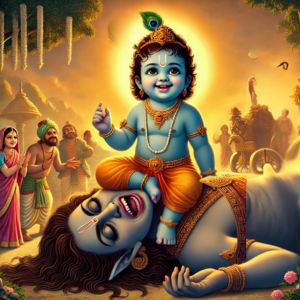
Finally, with a thunderous cry, Putana fell to the ground, her gigantic body stretching miles across.
When the people of Gokul came running, they saw baby Krishna playing fearlessly on her chest, smiling like the rising sun amidst the ruins of darkness.
And yet, the most miraculous thing happened a sweet fragrance of sandalwood and flowers spread from Putana’s body.
The poison was gone. The hatred was gone.
The demoness had attained Moksha liberation through Krishna’s touch.
The Meaning of Putana Moksha – Divine Mercy Beyond Judgment
The Putana Moksha Leela carries a deep spiritual message that touches the heart of every devotee:
Even the wicked can be purified by the Lord’s grace.
Putana came to kill, but Krishna gave her liberation.God looks at intention of the soul, not the actions of the body.
She came with poison, yet performed a motherly act and Krishna accepted that love.The Lord’s mercy knows no limits.
He didn’t destroy her; He delivered her.Every soul, even fallen, has divine potential.
Putana was liberated not because she was pure, but because Krishna is infinitely compassionate.
This Leela is the perfect example of unconditional forgiveness and divine love that expects nothing in return.
The Reactions of the People of Vrindavan
When the villagers saw the huge lifeless body of Putana, they were astonished.
The elders said, “This woman must have been a demoness sent by Kansa. Only our little Krishna could destroy such evil!”
Mother Yashoda rushed to her child, weeping with joy and fear. She took Krishna in her arms and embraced Him tightly, unable to believe that her baby had conquered death itself.
The Gopis and Gopas chanted with love:
“Jai Kanhaiya Lal Ki!”
“Glory to our Gopala, who protects us always!”
They bathed Krishna in holy water and performed purification rites, but in truth it was the world that was purified by the Lord’s divine act.
The Compassion of Krishna – The Heart of Putana Moksha
What makes Putana Moksha one of the most heart-touching Leelas is not the victory over evil, but the compassion behind it.
Krishna did not punish Putana for her sin. Instead, He accepted the smallest trace of motherly affection hidden within her act and magnified it into liberation.
In the Bhagavatam, it is said:
“Because she offered her breast to Krishna, even though it was with the intent to kill,
she attained the same spiritual position as His real mother, Yashoda.”
This shows the limitless mercy of the Lord He sees even the faintest spark of love and turns it into light.
The Symbolism of Putana Moksha
On a deeper spiritual level, Putana Moksha represents the cleansing of the heart.
Putana symbolizes the false attachments and desires that poison the soul.
The poison represents worldly illusion (Maya) that blinds us to truth.
Krishna represents pure consciousness and divine love, which destroys illusion and grants freedom.
When Krishna enters our heart even if it’s full of negativity His presence purifies everything.
That is Putana Moksha happening within us: the death of ignorance and the birth of divine love.
The Greatness of Krishna’s Mercy
The mercy shown in Putana Moksha is beyond comprehension.
Even the highest saints aspire for liberation after countless lifetimes of devotion. But Putana who came with hatred received it instantly.
Why? Because Krishna’s love is infinite.
He sees not just what we do but who we truly are souls longing for Him, even when lost in darkness.
In the Brahma Vaivarta Purana, it is said:
“The Lord is pleased even with a small act of devotion,
just as fire burns away a heap of sins with one spark.”
Lessons from Putana Moksha for Our Lives
Never judge anyone : even the fallen can be redeemed.
Every soul has the light of God within.Do not lose faith in divine grace.
If Krishna can liberate Putana, He can surely lift us from our struggles.Surrender removes poison.
The more we remember Krishna, the more negativity leaves our heart.Love transforms everything.
Even hatred can become devotion when touched by divine love.
Putana Moksha and Motherly Love
Interestingly, the scriptures say that Putana attained the same spiritual position as Krishna’s mother, Yashoda Maiya.
Why? Because Krishna accepted her as a mother — even for that brief act.
This shows that the Lord honors even the smallest relationship offered to Him with sincerity.
Just imagine — how merciful must Krishna be, that He gives the title of “mother” even to one who came to harm Him!
That is why devotees say:
“No one loves like Krishna, and no one forgives like Krishna.”
Putana Moksha in Devotional Art and Culture
Across India, Putana Moksha has inspired paintings, songs, temple carvings, and kathas.
In Vrindavan, devotees celebrate this Leela with deep reverence, understanding its meaning beyond mere storytelling.
In ISKCON temples, this pastime is often narrated to show Krishna’s childhood miracles and the compassion that defines His divine personality.
Every image of baby Krishna sitting on the fallen Putana reminds us that God’s love always conquers evil not by punishment, but by purification.
The Endless Grace of Putana Moksha
Putana Moksha is more than just a childhood story of Krishna. It is a divine lesson in love, forgiveness, and grace.
It teaches us that no heart is too dark, no sin too great, and no soul too lost when touched by Krishna’s mercy.
He is the one who transforms poison into peace, hatred into love, and fear into faith.
Just as He liberated Putana, He can liberate us when we open our hearts to Him.
“Even a moment of contact with Krishna brings eternal freedom.
Such is the power of His divine love.”
May we all experience our own Putana Moksha the day when Krishna removes our inner poison and fills us with His eternal love.
Hare Krishna! Jai Shri Putana Moksha! Radhe Radhe!