Holi in Vrindavan – The Festival of Divine Colors and Love
The Magic of Holi in Vrindavan
Holi in Vrindavan is not just a festival of colors it is a divine celebration of love, devotion, and the eternal bond between Radha and Krishna.
Every year, thousands of devotees from across the world travel to the sacred land of Vrindavan, Barsana, and Nandgaon to experience this magical festival, where colors become prayers and joy becomes devotion.
Unlike any other Holi in the world, Holi in Vrindavan is filled with bhakti (devotion). It is not merely about throwing colors; it is about recreating the divine pastimes of Radha and Krishna, where love flows like fragrance in the air.
When colors mix with chants of “Radhe Radhe” and “Shyam Shyam,” you don’t just see celebration you feel the presence of God in every heartbeat.
The Divine History Behind Holi in Vrindavan
The origin of Holi in Vrindavan goes back to the eternal love story of Radha and Krishna.
As the story goes, young Krishna, with his dark blue complexion, once asked his mother Yashoda Maiya,
“Why is Radha so fair and I am so dark?”
Yashoda lovingly replied,
“Go, my child, and put any color you wish on Radha’s face. Then both of you will be colored the same.”
And so, Krishna playfully smeared colors on Radha’s cheeks, beginning the divine tradition of Holi a celebration of love that transcends all differences.
From that day, Vrindavan and Barsana became the eternal centers of this colorful Leela, where every Holi is not just a festival, but a re-living of Radha-Krishna’s divine play.
The Spiritual Significance of Holi in Vrindavan
Holi in Vrindavan is far more than colors and fun it holds deep spiritual symbolism.
Colors Represent Love and Unity : Just as colors blend without distinction, Holi teaches that all souls are one in Krishna.
Burning of Ego : The Holika Dahan bonfire before Holi reminds us to burn our pride and negativity in the fire of devotion.
Surrender Through Play : Playing with colors symbolizes surrender letting go of control and letting divine joy take over.
Celebrating God’s Playfulness (Leela) : Holi expresses that God too loves to play, dance, and rejoice with His devotees.
In Vrindavan, even a handful of colors becomes a spiritual offering a prayer made with laughter, music, and love.
Where to Experience Holi in Vrindavan
The celebration of Holi in Vrindavan is not limited to one day or one place.
It unfolds over several days across different towns, each with its own divine flavor.
1. Barsana : Lathmar Holi
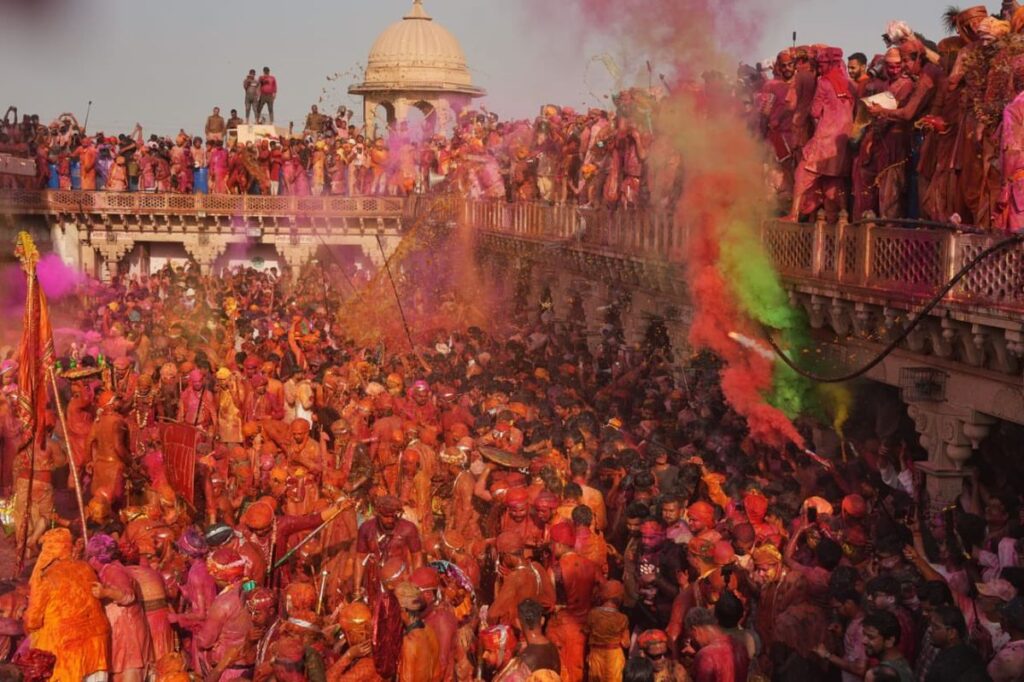
Barsana, the birthplace of Srimati Radharani, celebrates one of the most famous forms of Holi : Lathmar Holi.
According to tradition, the men of Nandgaon (Krishna’s village) visit Barsana to play Holi with the women (Gopis).
The women, pretending to be angry, playfully beat the men with sticks (lath) while the men defend themselves with shields.
This beautiful tradition symbolizes Radha’s loving dominance over Krishna : where love expresses itself through teasing, laughter, and divine play.
The atmosphere fills with chants of:
“Shri Radhe! Shyam Shyam!”
and songs that make the heart dance with devotion.
2. Nandgaon – The Return Holi
The next day, Holi moves to Nandgaon, the village of Krishna.
Here, the men of Barsana visit to play colors with the women of Nandgaon.
It represents the loving exchange between Radha’s and Krishna’s sides, symbolizing that divine love flows equally from both.
The temples are adorned with flowers, and the villagers rejoice in a festival that feels like a reunion of souls.
3. Vrindavan – Phoolon Wali Holi (Flower Holi)
In Vrindavan, the celebration reaches its peak at temples like Banke Bihari, Prem Mandir, and ISKCON Vrindavan.
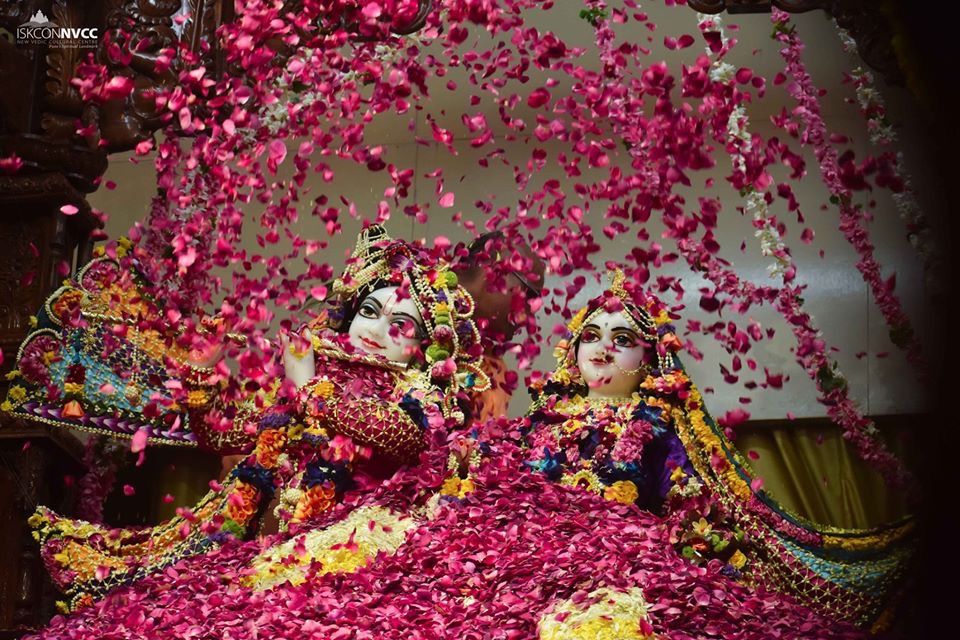
Here, instead of dry colors, devotees play Holi with flowers — marigold, rose, and jasmine petals showered on the deities and devotees alike.
This is known as Phoolon Wali Holi, the Holi of flowers, where fragrance replaces color and love replaces play.
The air becomes a garden of devotion as petals fall like blessings from the heavens.
4. Widow’s Holi : The Celebration of Acceptance
A few years ago, Vrindavan began a new and touching tradition the Widow’s Holi.
Organized by the Sulkhan Foundation and local ashrams, this Holi allows widows from Vrindavan’s ashrams to play colors, sing bhajans, and celebrate life again.
It’s a moment of divine inclusion showing that in Krishna’s world, everyone deserves love, joy, and dignity.
Seeing these women smile, dance, and sing “Radhe Radhe” brings tears of devotion to every heart.
The Divine Atmosphere During Holi in Vrindavan
During Holi in Vrindavan, the entire town transforms into a living poem of devotion.
The air is filled with gulal (colored powder) and the sound of flutes, mridangas, and kartals.
The temples resound with bhajans like “Aaj Biraj Mein Holi Re Rasiya” and “Radhe Radhe Japo, Shyam Milenge”.
Streets glow with colors, laughter, and chants of “Jai Shri Radhe!”
Every face you see is smiling, every heart is open. Even strangers embrace each other with love because in Vrindavan, everyone is a devotee of Krishna.
The Inner Meaning of Holi in Vrindavan
The deeper message of Holi in Vrindavan goes beyond colors : it is about coloring the heart with devotion.
When Krishna colored Radha, He wasn’t just playing : He was teaching that God and devotee are one through love.
The true Holi happens not outside, but within the heart:
When jealousy turns into joy.
When hatred turns into compassion.
When ego dissolves in surrender.
That is the real Holi : the Holi of the soul.
Holi in Vrindavan and Bhakti Tradition
In the Bhakti movement, saints like Chaitanya Mahaprabhu, Meera Bai, Surdas, and Nanddas celebrated Holi as a festival of divine union.
Chaitanya Mahaprabhu’s Holi was filled with ecstatic kirtan, where devotees would dance, cry, and chant Krishna’s name till they lost themselves in love.
Meera Bai sang,
“Rang rangili Radha, rang le Shyam pyare,
Holi khelt Vrindavan mein, Radha ke sang Nandlal re.”
Through their songs, these saints taught that Holi is not about color on skin it’s about coloring the heart with Krishna’s name.
How Devotees Celebrate Holi Spiritually
On Holi in Vrindavan, devotees don’t just play with colors they immerse themselves in prayer and service:
Morning Kirtans : Singing “Hare Krishna” with instruments and dance.
Temple Darshans : Visiting Radha Raman, Banke Bihari, and ISKCON temples.
Offering Colors to Deities : Placing gulal at Krishna’s feet before playing.
Bhajans & Satsangs : Listening to spiritual discourses about Radha-Krishna Leelas.
Feasting on Prasadam : Sharing sanctified food in joy and gratitude.
In this way, Vrindavan turns Holi into a yajna of love a divine offering of devotion.
Lessons from Holi in Vrindavan
Love is the Greatest Color.
Just as Krishna filled Radha with color, fill your life with love and kindness.Forgive and Rejoice.
Holi reminds us to let go of the past and start fresh with open hearts.See God in Everyone.
When you color someone, see Krishna’s presence in them.Celebrate Inner Joy.
Real happiness comes from connection with the Divine, not worldly pleasure.Live with Bhakti.
Every act of joy can become devotion if done with a heart that remembers Krishna.
Modern-Day Holi in Vrindavan
Even today, Holi in Vrindavan draws pilgrims and travelers from around the world.
Cameras capture the colors, but what truly moves people is the feeling of peace and belonging they experience.
Foreigners dance with locals, widows sing with children, and everyone chants together
“Radhe Radhe Shyam Milenge!”
The streets of Vrindavan remind us that love has no religion, no nationality it is universal and divine.
The True Colors of Holi in Vrindavan
Holi in Vrindavan is not merely a festival it is a spiritual experience, a journey from the outer world of colors to the inner world of love.
It teaches us that:
When the soul meets God, every moment becomes Holi.
When the heart fills with devotion, life itself becomes color.
When we love selflessly, we touch the divine.
So, this Holi, let us not just color each other’s faces let us color the world with love, peace, and the name of Radha-Krishna.
“Vrindavan ki Holi, prem ka utsav hai,
Jahan har rang mein bas ek naam hai – Radhe Shyam.”
Jai Shri Radhe! Jai Shri Krishna! Radhe Radhe!