Gopashtami – The Day Krishna Became a Cowherd
The Divine Significance of Gopashtami
Gopashtami is one of the most sacred and joyful festivals celebrated in Vrindavan and across India. It marks the day when Lord Krishna, the beloved son of Nanda and Yashoda, was given the responsibility of herding cows for the first time.
This day signifies Krishna’s transition from childhood (Baal Leela) to boyhood (Paugaṇḍa Leela) a moment that symbolizes growth, responsibility, and divine service.
More than just a cultural celebration, Gopashtami teaches us about love, humility, and the deep relationship between God, nature, and all living beings.
It reminds us that Krishna the Supreme Lord joyfully chose to live among simple cowherds, showing that divine love shines brightest in simplicity.
The Story Behind Gopashtami – Krishna’s First Day as a Cowherd
In the village of Gokul, little Krishna spent His early years playing with calves and His friends the Gopas and Gopis. He would delight everyone with His laughter, mischief, and sweet flute music.
When Krishna turned seven years old, His father Nanda Maharaj decided it was time for Him to take up a new responsibility herding the cows instead of the calves.
Traditionally, in Vedic culture, when a boy reached this age, he began assisting his elders in taking care of cows a sacred duty known as Gopa Seva.
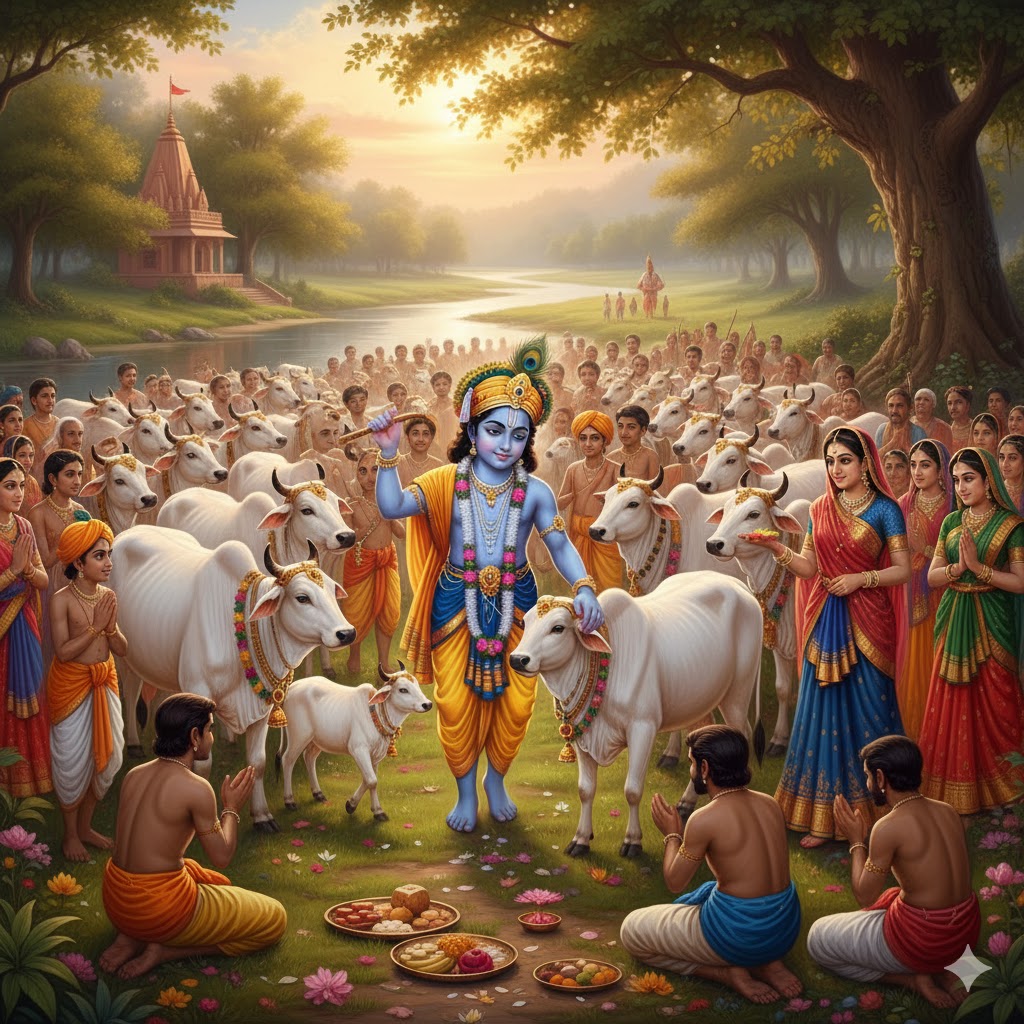
Thus, on this auspicious day, Nanda Baba organized a beautiful ceremony to mark Krishna’s initiation as a full cowherd. This event became known as Gopashtami.
The Celebration in Vrindavan – A Scene of Divine Joy
The entire village of Vrindavan was filled with excitement on the first Gopashtami.
The cows were bathed, decorated with garlands, and their horns were painted in bright colors. Krishna and His elder brother Balarama were dressed in shining yellow and blue garments, adorned with flower garlands and peacock feathers.
As Krishna prepared to take the cows to the forest for the first time, Mother Yashoda’s eyes filled with love and concern. She blessed her son, saying,
“May the forest protect You, my child, as You protect the cows.”
Krishna smiled mischievously, reassuring her that no harm could ever come when He was with His cows and friends.
The Role of the Cows in Krishna’s Leela
In Gopashtami, the focus is not only on Krishna but also on the sacred cows of Vrindavan, who are considered His dearest companions.
For Krishna, cows were not just animals they were expressions of divine love and purity.
He named each cow personally and would call them by name with the melody of His flute.
The scriptures say that when Krishna played His flute, the cows would stop grazing, lift their heads, and tears of joy would fill their eyes. Such was their bond with Him.
The cows symbolize gentleness, giving, and unconditional love qualities that reflect the divine nature of God Himself.
The Beautiful Legend of Radha and Gopashtami
There is also a sweet and touching story connected with Gopashtami involving Srimati Radharani.
When Krishna and Balarama set out for the forest with the cows, Radha wanted to accompany them.
However, Nanda Baba had declared that only boys could go cowherding.
Determined not to miss Krishna’s first day as a cowherd, Radha disguised Herself as a boy and joined the Gopas in the forest.
Seeing Her pure love and devotion, Krishna smiled knowingly for even in disguise, the Lord recognizes the heart of His devotee.
This Leela teaches that true devotion knows no boundaries or rules it flows purely from love.
The Meaning and Message of Gopashtami
Gopashtami holds a profound spiritual meaning that touches the heart of every devotee.
Symbol of Service:
Krishna, though the Supreme God, took joy in serving the cows : teaching us that service to others is the highest form of worship.Symbol of Humility:
By becoming a cowherd, Krishna showed that divinity resides in simplicity and that true greatness lies in humility.Love for Nature and Living Beings:
Cows are symbols of Mother Earth’s nurturing nature.
Taking care of them is like taking care of the entire creation.Path of Devotion (Bhakti):
The relationship between Krishna and His cows represents selfless love and surrender : the essence of Bhakti Yoga.
How Gopashtami Is Celebrated
Gopashtami is celebrated with great devotion, especially in Vrindavan, Mathura, Barsana, and across Gaushalas (cow shelters) in India.
1. Gau Puja (Cow Worship)
Devotees wake up early, bathe and decorate the cows with garlands, kumkum, and sandalwood paste.
They offer food, incense, and lamps to honor them as divine mothers.
In temples, special pujas and aartis are performed for Krishna and the cows, followed by singing of bhajans like:
“Govinda Bolo Hari Gopala Bolo”
“Radhe Govinda Gopala Murari”
2. Krishna-Balarama Procession
In Vrindavan’s temples like ISKCON, Banke Bihari, and Radha Raman Mandir, Krishna and Balarama are dressed as cowherds.
A grand procession is held with devotees dancing, singing, and playing instruments as they escort the deities.
3. Feeding Cows (Gau Seva)
Devotees feed cows with grass, jaggery, and sweet treats as an act of love. It is believed that serving cows on Gopashtami brings immense spiritual blessings.
4. Children’s Participation
In many temples and homes, children dress up as Krishna, Radha, and cowherds and reenact the Gopashtami Leela, learning about the importance of service and devotion.
The Importance of Cows in Sanatan Dharma
In the Vedic scriptures, the cow is regarded as “Kamadhenu”, the wish-fulfilling mother who provides nourishment to all beings.
The Atharva Veda calls the cow Aghnya, meaning “one who should never be harmed.”
Krishna Himself is known as “Gopal” and “Govinda”, which means protector of cows and giver of happiness.
Serving cows is considered equivalent to serving the Lord, because Krishna’s heart beats in the love of the cows of Vrindavan.
Gopashtami in Vrindavan – A Festival of Divine Love
In Vrindavan, Gopashtami is celebrated with overwhelming devotion.
The temples are decorated with flowers and lights.
Devotees perform parikrama (circumambulation) of the sacred Govardhan Hill.
Gaushalas (cow shelters) organize special feeding programs and bhajans.
Everywhere, you can hear the chants:
“Radhe Radhe! Govinda Gopala!”
The air itself feels filled with the sweetness of Krishna’s flute and the love of His devotees.
The Spiritual Lesson of Gopashtami
Gopashtami is not only a remembrance of Krishna’s childhood pastime it’s a lesson for our own lives.
It teaches:
Serve with love, not pride.
Protect nature and animals.
Find divinity in simple acts.
Love God through His creation.
When we serve others selflessly, we are walking the same path Krishna walked as a cowherd the path of compassion and divine joy.
How to Celebrate Gopashtami at Home
You can celebrate Gopashtami beautifully and devotionally at home:
Wake up early and bathe Krishna’s deity or picture.
Offer milk, butter, fruits, and sweets to Lord Krishna.
Perform Gau Puja : if you have access to cows, feed them lovingly.
Decorate your home altar with cow and calf images, flowers, and lamps.
Chant and sing Krishna Bhajans throughout the day.
Read or narrate the story of Gopashtami to children and family members.
The true celebration lies in your heart’s purity and your intention to please Krishna
Symbolic Meaning – Krishna, the Protector of All Beings
When Krishna became a cowherd on Gopashtami, He showed that God protects every living being, no matter how small.
The cows represent the innocent souls seeking guidance, and Krishna represents divine compassion that shelters them.
In today’s world, Gopashtami reminds us to extend our love not just to humans, but to all of God’s creation animals, plants, and nature itself.
The Eternal Message of Gopashtami
Gopashtami is a festival of devotion, humility, and love.
It celebrates the moment when the Supreme Lord, out of His boundless love, chose the simple life of a cowherd to serve, to protect, and to love.
It teaches us that true divinity lies in service, not power; in simplicity, not status.
On this sacred day, let us bow to Lord Krishna the eternal Gopal, and pray:
“O Krishna, make my heart as pure as the cows of Vrindavan,
Let me serve You with love, just as You served them with joy.”
Jai Gopal! Jai Govinda! Jai Shri Krishna! Radhe Radhe!